Watching the Odyssey
Marianne Janack
Like many, many people, I was eager to see Christopher Nolan’s version of Homer’s Odyssey. And like many people, I saw the enhanced—and very loud—version. I saw it with my daughter, who read Homer’s Odyssey in college; I’d read it several times, most recently a few years ago when I read it along with The Iliad with my summer reading buddies. Though Nolan’s telling of the story has been criticized because it isn’t true to the original, I still think it’s worth seeing. Though I’d skip the enhanced version if I were to do it again.
There are, of course, the standard characters: Odysseus (of course); Penelope; Telemachus; Argus; Eumaeus; the maids; the suitors; the Cyclops; Circe; Calypso; Athena. And the story is about heading home. But Odysseus is more sympathetic in this version than I found him when I first read The Odyssey. When I read the poem, I remember Odysseus’s trip home as a series of affairs he had, and tricks he plays. But in the movie, he doesn’t have affairs: his stay on Calypso’s island is accidental because he doesn’t remember his past, and he is not seduced by Circe. He is a survivor, and a loving husband. And he regrets that Trojan horse stunt.
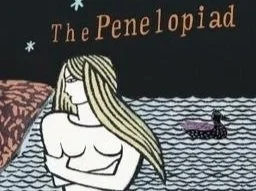
Not to get all feminist on your ass, but if you watched the movie or read the story, you owe it to yourself to read Margaret Atwood’s Penelopiad. The Penelopiad tells us of Odysseus’s journey from Penelope’s perspective and from the perspective of the twelve maids who were hanged for having relations with the suitors. We hear about Penelope’s life before she married Odysseus, and her reflections on being in Hades. The maids serve as a Greek chorus, but their takes on the story and on Penelope are decidedly critical.
And then there’s Helen. In The Penelopiad, Penelope blames her for the war and for the fact that Odysseus was taken away for years to fight in Troy: “I’ve often wondered whether, if Helen hadn’t been so puffed up with vanity, we might all have been spared the sufferings and sorrows she brought down on our heads by her selfishness and her deranged lust. Why couldn’t she have led a normal life? But no – normal lives were boring, and Helen was ambitious. She wanted to make a name for herself. She longed to stand out from the herd. When Telemachus was a year old, disaster struck. It was because of Helen, as all the world knows by now.”
But if this is a feminist book, it’s an odd one: it’s not clear that Penelope is a reliable narrator. The maids seem to see things and know things that she doesn’t, which makes us wonder if she’s to be trusted. Her animus against Helen seems to be a rivalry born of classic femininity: she envies Helen’s beauty; she sees Helen as a rival for the attention of the men in their lives; and she even casts doubt on the account of Helen’s birth (Helen was said to have been born as a result of the rape of her mother by Zeus). Atwood disputes the claim that The Penelopiad is a feminist retelling of The Odyssey, saying that any story told from the perspective of a woman is called ‘feminist’. And Atwood’s poem told from the perspective of Circe (Circe: Mud Poems) says of Penelope:
She's up to something, she's weaving
histories, they are never right,
she has to do them over,
she is weaving her version
The Penelopiad shows us how much perspective matters, and how much the story-teller and the audience matter. Christopher Nolan is a story-teller, and The Odyssey movie is not the book we read in college, and the book we read in college is not the story told by bards. In fact, it’s not even clear that ‘Homer’ was a single author—or that The Odyssey was composed by one person. Christopher Nolan’s version is another version—as is Penelope’s.