The Spurious Perversity of Lolita
Gabriela de Mendonça Gomes
“How long is it since you were really bothered? About something important, something real?” Fahrenheit 451’s Guy Montag asks his deeply detached, technology obsessed wife Mildred. The prickly sentiment that Montag’s question engenders is the one around which I find the waters of mind eddying as I contemplate the deathless discussion around Nabokov’s Lolita.
Last time we wrote about Nabokov, I settled on majorly sidestepping the landmine question of Lolita. I decided, instead, to write about memory and scrutiny, as it is eminently clear Nabokov held carefulness in observation in the highest regard when it comes to reading, writing, and living.
The “perennially problematic” question of Lolita has been alive since the text was published—which took a while. As Associate Professor at Griffith University Sally Breen, explains, “the manuscript of Lolita was initially rejected by every American publisher who considered it. It was eventually published in France in 1955 by the notoriously fearless Maurice Girodias, who also published English language versions of books censored in Britain and America, including works by Henry Miller, Anaïs Nin, Samuel Beckett and William Burroughs, among others.” And, of course, after it was published in the United States, it suffered ceaseless censorship.
Anne Dwyer, a professor of German and Russian at Pomona College, published an article titled “Why I Teach Lolita,” wherein she writes of her undergraduates’ objections to her teaching the novel in a Nabokov class. The next class she delivered a lecture, which began with her responding, “I was not surprised by the vehemence of your response to the book, but by the suggestion that we should perhaps not read it at all.”
How come people not only hate Lolita but refuse to read it entirely? The most obvious answer is: because of its subject. Lolita is a story about a man who is obsessed with a very young girl. This man, Humbert Humbert, is, in plainest terms, a pedophile, and he’s our narrator. Thus, there’s an immediate adverse reaction, a moral rash rushing red up the arms of the reader, because we’re supposed to shun pedophiles. Even more damning and made inevitable by the mechanics of reading, two voices become one in narration. Therefore, if you let yourself read Lolita, the worry may follow is that you’re letting a pedophile use your voice which you identify with your non-pedophilic thoughts. Moreover, now, your voice is narrating his disturbing story because, as the reader, we have no option but to adopt the narrator’s perspective in the storytelling act. In a first-person point of view––as in Lolita––we are narratively limited to that character’s words, observations, and feelings. And when we feel a large disjunction between ourselves––non-pedophiles––and our narrator––an obvious pedophile––we recoil at the idea of having to share our insight into the novel’s world filtered through his perspective.
What puzzles me about many Lolita rejectors, however, is that this category mistake—confusing depiction for endorsement—doesn’t carry over into other areas of entertainment or study: true crime series, movies, podcasts, and books and 'getting into the minds of killers’ is epidemically popular in the United States. For me, it becomes thereafter hard to argue that the widespread fascination with Dahmer or Bundy––similarly disturbing and real figures about whom there are not one or two documentaries, but umpteen series, movies, and videos both in the fiction and the non-fiction genre––is somehow of a less perturbed ilk.
Is the issue that it’s fiction? Meaning that Nabokov spent time in the mind of a perturbed man? Because, if you’ve read American Psycho or Crime and Punishment, I might again point out another layer of hypocrisy. I may add that you’re potentially falling prey to the illusion that narrators are supposed to be reliable, and relatable. Humbert Humbert’s creepiness is presupposed, and he is the quintessential unreliable narrator.
In his essay, “Good Readers and Good Writers,” Nabokov argues that, “if one begins with a ready made generalization, one begins at the wrong end and travels away from the book before one has started to understand it.” By the way, however, this doesn’t mean that anyone, including Nabokov, believes that the reader should be giving H.H. the benefit of the doubt or a charitable reading; the foreword to the novel is framed as an editorial note by a fictional psychologist, Dr. John Ray, Jr. who calls H.H. “horrible,” “abject,” and a “shining example of moral leprosy.” So, no one goes into Lolita thinking he’s the good guy––or at least they shouldn’t.
Professor Dwyer reconstructs her students’ claim that “by assigning Lolita I am perpetuating trauma and may even be perpetuating rape culture.” And retorts “this last suggestion runs so counter to my own beliefs about what literature does.” Because there’s an important distinction to be made, which nowadays seems to have become forgotten when it comes to works of literature: representation does not equal romanticization.
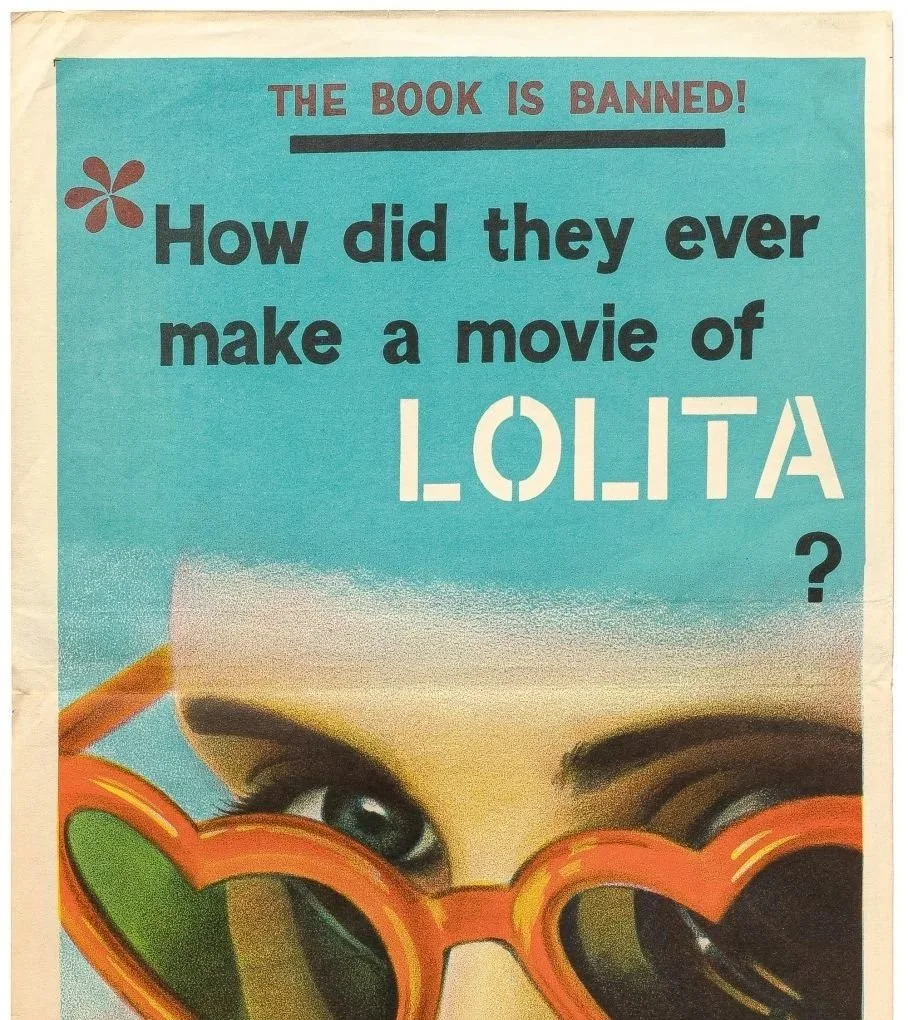
Nabokov goes on to say: “Nothing is more boring or more unfair to the author than starting to read, say, Madame Bovary, with the preconceived notion that it is a denunciation of the bourgeoisie.” The tedious and benighted nature of this procession strikes a clear resonance with his own text. I had a wonderful literature professor who told us never to read the back of the novels we were reading in her class. I think for the same reason which caused Lolita, after having been made into two movies––the second of which, directed by Stanley Kubrick, maintains as its (in)famous sign-spinner tagline, “How did they ever make a movie of Lolita?!”––to have become stuck to the cultural consciousness like enduring gum on a rubber sole as ‘The Pedophile Book.’
Nabokov didn’t seem to mind so much. In a 1964 interview for Life Magazine, he, cheeky as ever, said, “I would say that of all my books Lolita has left me with the most pleasurable afterglow—perhaps because it is the purest of all, the most abstract and carefully contrived. I am probably responsible for the odd fact that people don’t seem to name their daughters Lolita any more.”
But I mind. And Marianne minds. We roll our eyes at those who roll theirs at us when we place Lolita in high echelons of our great books lists. We think like the author of Reading Lolita in Tehran and professor at the University of Oklahoma, Azar Nafisi, who stated in an NPR interview: “There is so much miscomprehension about this book. Unlike what some people acclaim, this book is not a celebration of a pedophile’s love for a 12-year-old child. But it is, in fact, about the cruelty of not seeing other people's reality, of imposing your own desires and your own illusions upon someone else's life and reality, the way Humbert did with Lolita.”
And another thing, Lolita is more about America, postwar America—it’s temporal setting—and present-day America than anything else. Hand-in-hand with H.H. being the quintessentially unreliable narrator is the novel’s quintessentially Americanness presented in its tropes: the road trip he takes with Dolores, the life in suburbia in which he first encounters her, the U.S. popular culture allusions strewn throughout the novel, the fact that it begins with an extensive allusion to Poe’s “Annabel Lee.” Just as we ought to be suspicious of H.H.’s nomial transfiguration of Dolores into Lolita, erasing the pain and replacing it with imposed seductive obsessions, so should we throw a scrutinizing eye on the narratives the U.S. was/is weaving about itself.
And this warning is more relevant than ever. As Professor Breen points out, we are living in a world where young girls are, and have been since before Nabokov’s novel, serially commodified. The darkest side of this perverse cultural valuation has been presented to us in its most bare-face cruelty in the release of the Epstein files. How Nabokov’s gripping, seductive prose hides within it profound violence teaches us to be disgusted with that behavior and that deliberate erasure, which stands in stark contrast to the way that the glorification of the modeling and beauty industries that incessantly and insidiously hide, suppress, and normalize the abuse and exploitation of the young and vulnerable. In the past five years, there has been a meteoric rise of young women commodifying their own bodies on platforms like OnlyFans. While it is not a larger institution, like in modeling, these platforms operate on a false sense of empowerment. While they purport to empower women by allowing them to take agency over their sexuality and monetize it on their own terms, the nature of this digital sexwork platform differs little from ages-long the capitalistic and patriarchal exploitation of young women. The narrative of self-empowerment that OnlyFans promotes can be much likened to the narrative that Humbert Humbert weaves of Dolores’ seduction of him: false, and created by the person in power who benefits from the vulnerable’s participation—which is never the vulnerable party herself.
In Lolita, we see the mechanizations of Humbert Humbert’s mind and the formation of his delusions, but Nabokov never fails to remind us of the true horror into which Dolores has had the misfortune of being dumped. As Breen concludes: “Moral outrage over a book is a convenient deflection and does nothing to stem the tide of abhorrent behaviours.” Lolita is a tale that explores the dark things; pedophilia and the exploitation of young woman are not realities we are glad to witness, yet being indignant about the text fails to make you less against pedophilia than anyone else, Nabokov included. Indeed, not reading Lolita is convenient. It lets you live unbothered, shielding yourself from the discomfort. It’s self-censorship that allows you to sink further into the deeply cushioned chair that’s swallowed you up to your throat before you realize it.