The Problem of Keeping Your Words
Gabriela de Mendonça Gomes
I’ve always held a love and fascination for stationery and notebooks. At perhaps 8 or 9 years old, I remember wanting to write a diary—specifically because I wanted to write in those pink, pleather or faux-fur and heart-shaped-lock-endowed diaries that decorated the check-out aisles of the preteen clothing stores of my youth. But that was more about the items of the habit rather than the habit itself. I had some version of that already implanted into my weekly schedule because in the third grade we had to write journal entries upon arriving to school. I remember writing about my father leaving for Brazil, leaving our family. I remember the teacher corrected “bro” to “brother” and left no other comments.
The diary fixation was a subgenre of overarching fascination with the idea of writing, of being someone who writes; it no doubt arose from the same bud that flowered into my love of books and reading. After all, in order to be able to read a book, someone has got to have written it. And someone’s got to be that someone.
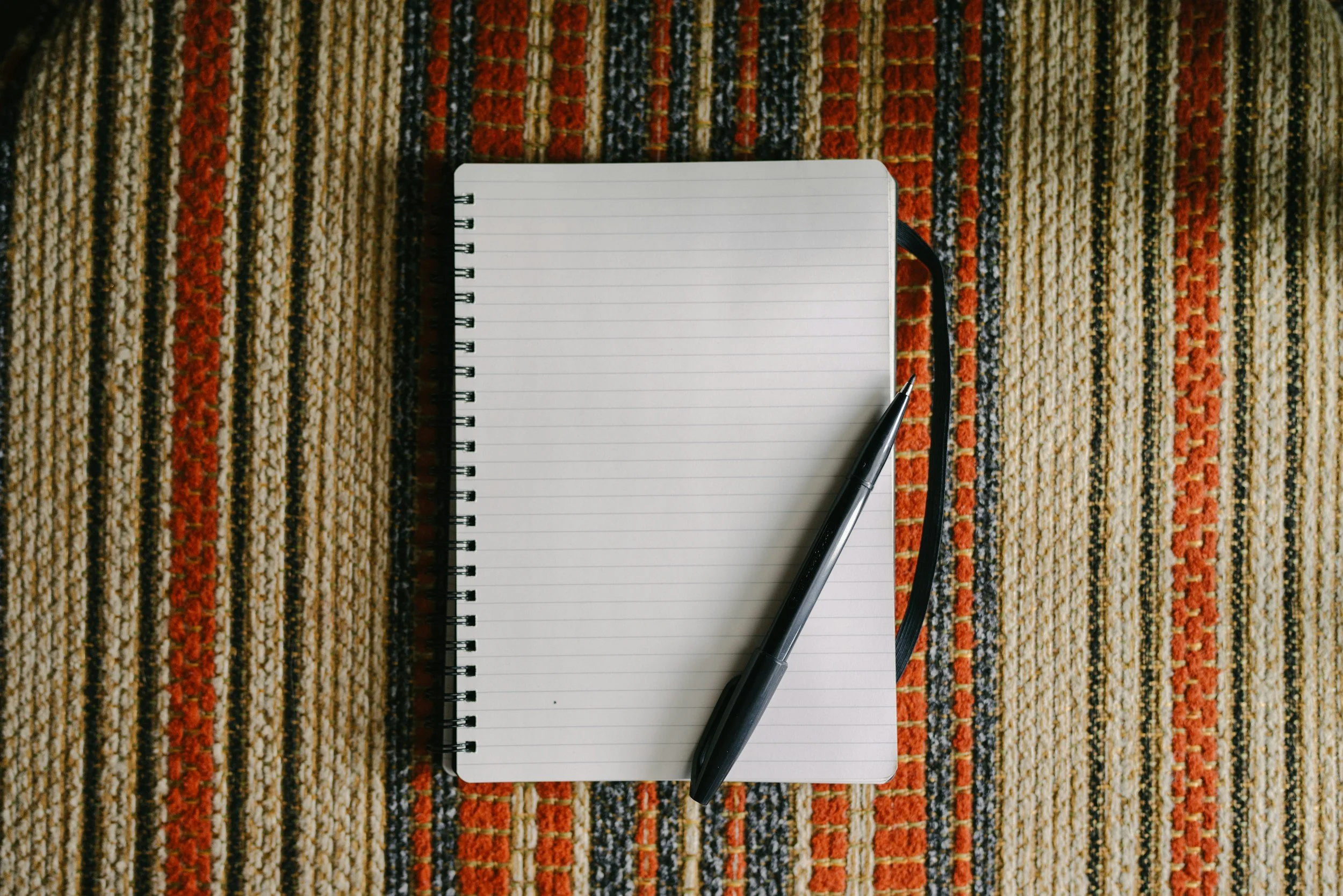
With my parents, and then alone when I was old enough, I’d go to paperies and browse the aisles of beautiful writing utensils and vessels, sometimes buying some item, sometimes just admiring. On one of these trips in my middle grade years, alone this time, I left with a black moleskine notebook and a purple stabilo thin-pointed felt pen. I sat in the tram—I lived in Amsterdam then—and took the leap. In lilac ink on lined paper, I set a date at the top of the page and began inscribing words. If I know myself, I know I began with writing that I didn’t know how to begin writing. In fact, I remember it now. I remember the yellow of the lights, the blue and white striping of the tram car, the lively lilac.
Since that day, about fifteen years ago at this point, I have regularly written in diaries. Every single diary, I still have. There are perhaps twenty or thirty of them, perhaps more. I have not counted. I left them at my mother’s apartment across the country. I moved earlier this year, and, when moving, one must be selective. One cannot afford to bring everything. All 1,000 of my books, I brought. Almost all. The empty notebooks, too, came to an opposite coast. But the full ones, I’ve never been quite sure what to do with. It feels wrong to throw them away, in the same way it feels wrong to bin a childhood stuffed animal. It was a part of me. It is a memory of a me that is external and distinct from the current one.
I’ve considered burning them, an act of catharsis. But besides being afraid of setting off the building’s fire alarm, notebooks are delicate things. Burning them is such a violent act, reminiscent of burning books. In Fahrenheit 451, after the protagonist witnesses a woman refuse to leave her books, he ponders: “There must be something in books, something we can’t imagine, to make a woman stay in a burning house; there must be something there. You don’t stay for nothing.” I didn’t write those things down for nothing. In fact, I wrote them for very particular reasons.
When you write creatively, or when you teach, an aspect you consider is your audience. Will my audience understand what I mean when I refer to a certain concept, or do I have to scaffold in explanations and definitions? When you are your own audience, the question of mutual understanding is outstripped by a question of honesty: how honest are you willing to be with yourself? I’ve caught myself in moments writing about something and knowing that’s not quite how I feel about it, or that I’m not being 100% transparent in what I’m writing. Which is interesting—for many reasons. Because even though I am my own audience, it’s not like I typically revisit my old diary entries. I, in fact, almost never do.
When I was organizing the things at my mother’s apartment for my move, I saw the box of diaries. I went to it, and my fingers hesitated in the crevice between thin pages of a white moleskine notebook, dated 2014––probably notebook #3 or #4. Upon a cursory glance, I decided, alá Bartleby, that I’d rather not continue on. So, when the narrating ‘I’ feels tension with the narrated ‘I’, the reason doesn’t seem to come from fear of a future self’s judgment, because I know that future self doesn’t want to read what that former one has written. What I think I’m fearful of is the concreteness of putting the true words on the page, of giving them an embodiment.
In his speech, “This is Water,” David Foster Wallace said “the most obvious, important realities are often the ones that are hardest to see and talk about.” The presupposed privacy embedded within the concept of writing a diary should provide me the freedom to discuss any topic that doesn’t fit into the array of social settings through which I circulate. And, for a majority of the time, I am honest––deeply honest in that way that would be ugly anywhere besides the arena of diary. The diary is where I pour my emotions in their raw state, where I stabilize internal frenzy, where I make lists (I love a good list), where I allow my mind to follow the streams of my consciousness into whatever tributaries it takes. I never leave my diary entries more confused or upset than before. There is always an undercurrent of things getting worked out.
Indeed, by narrativizing things, I make sense of them. By writing these parts of myself on paper, an internal monologue becomes an internal dialogue, with interlocutors—various versions of myself, various voices within me. Studying philosophy and literature also trained me to more easily adopt different stances and be empathetic towards those whom—or those parts of myself which—I intuitively put in opposition to myself. In turn, I’ve come to recognize that I shouldn’t actually believe every thought that crosses my mind. I’ve noticed how within myself, there exist statements and claims over my sense of identity and worth that don’t actually come from my soul, but that are others’ perspectives that I subconsciously adopted over time. Some of those I keep, even if they weren’t authored by me. Some of them, I discard—or try to. Perhaps even the recognition of internal disjunct and dishonesty is in and of itself a valuable piece of data to have when it comes to reaching a stronger sense of self-understanding, which, to me, is one of the main points of diarykeeping.
The question of truth-value, however, is interesting. I have long felt that one of the most valuable aspects of literature to me is when a book presents words I’ve seen before in a certain order such that they describe and capture something in my life I’d felt before but never understood so clearly as until at that exact moment, crystalized in that phrase. Fernando Pessoa’s The Book of Disquiet. Bradbury’s Fahrenheit 451. Rumi’s poetry. Marcus Aurelius’ Meditations. Virginia Woolf’s A Room of One’s Own. It’s remarkable how reading someone else’s writing can shatteringly clarify my internal opacity. And it’s remarkable how many of the texts that enable those revelations for me are fictional. Reading about fictional characters, I learn about real and true things about myself, others, and our shared worlds. And although I come away from diary entries with a sense of relief or greater understanding, almost never is it a result of my precise wielding of form and language the way the revelations come through fiction or poetry.
In the diary, it’s a result of linguistic investigation, but the factual, expository nature of diary-writing, the mundanity of it, doesn’t result in the same magical feeling of being seen in the same way that reading literature can. Even though I dialogize myself through diary writing, the recognition that comes from the self perhaps doesn’t retain the same value as recognition from a separate soul. The private banality of the diary supersedes all else, perhaps. As profoundly social creatures, we are always seeking validation, community, and belonging. The communion with the imaginative, psychological, and emotional facets of another human’s mind that reading a piece of literature allows—albeit often mediated through the imaginative veil of fiction and always thought physicality of the page—is distinct from the catharsis of diary writing, and powerful in a different way. The diary is the place for the mind to extend its tendrils as messily as it would like. Literature is the wormhole—or womb—that connects minds and hearts across time and space. So what happens when a diary becomes literature? Or is that impossible?
One reason, besides karthasis, that I have considered burning or somehow relieving myself of my old diaries is that I have this fear that they will be looked at after I die. I recently made a video and wrote an essay about Franz Kafka and the Anxiety of Judgment, and some writing I read in preparation for it—not all the way through admittedly, as they are very long—are Kafka’s diaries. Alongside his famous fictional corpus published posthumously, his close friend and estate executor, Max Brod, published a redacted version of his diaries. Brod attempted to help Kafka save some face by censoring them, but in 2024, translator Ross Benjamin published Kafka’s complete and uncensored diaries. This is the edition I have. Therein lies a question of ethics. The reading public are certainly the better for Brod’s disregard of Kafka’s wishes, but, if you believe in the dead’s possession of autonomy and right to privacy, it can certainly feel like some ethical boundary has been violated. I certainly wouldn’t want my diaries published, or even read by anyone, after my death. In fact, were I to know of my imminent death, I would likely destroy them myself or, like Kafka, ask them to be burned. But then again, I’d be dead; so what does it matter to me? I guess it matters to my memory, to those who are still alive.
Although the origin of the phrase is unclear, as I was considering this idea of posthumous pride and privacy, I thought of the quote about how all people die three deaths. The best formulation I found of it is from American neuroscientist David Eagleman’s book Sum: Forty Tales from the Afterlives: “There are three deaths. The first is when the body ceases to function. The second is when the body is consigned to the grave. The third is that moment, sometime in the future, when your name is spoken for the last time.” Eagleman, here, considers living on in memory as a type of life, or afterlife. Although the self that could physically and emotionally object to others reading my private writings wouldn’t exist, the image of the self, the associations that form in the stalls of other’s minds when my name arises, would change. Is my self then also changed? Was Kafka’s self changed? Was it for the better? I guess that depends on what we mean when we say ‘better.’
As a reader and scholar, I am definitely the better for having read Kafka’s works and his diaries. In his diaries, I feel kindred in his descriptions of his despair in the “unending torments” of writing and his sense of alienation from himself, which can also be seen, quite by contrast, in a meditative (and positive even) Buddhist light: “Forget everything. Open the windows. Clear the room. The wind blows through it. You see only its emptiness, you search in every corner and don’t find yourself.” I am certainly the better for having read what can be considered as Marcus Aurelius’ diaries, his Meditations—one of the guiding texts of my life. The reminder that “you are part of nature, and no one can prevent you from speaking and acting in harmony with it, always”(II.9) and “not to be overwhelmed by what you imagine, but just do what you can and should. And if you suffer in inessentials, not to treat that as defeat. (Bad habit)” (V.36). I would be a different person had I not read those. But my diaries are not beautiful, or well written.
They are plain, poor even. Kafka and Marcus, and friends of mine I know write beautiful diary entries that they edit and publish and share. I must acknowledge that some of Kafka’s diaries are not beautiful; they can be dull and repetitive, or confusing (e.g. there are many reviews of theatre performances which, to me, are pretty uninteresting). And that’s because, as I am in my diaries, Kafka was writing for himself. Or, for no one else. Max Brod cited Kafka’s excessively high standards as one of the primary reasons that Kafka himself didn’t publish his novels and why Brod was thus compelled to do so on Kafka’s behalf. Naturally, if you do any research into Kafka and his diaries, you will find people discussing how they reveal a much messier, more complex, and more sensual person than his other writing betrayed—Marianne’s newsletter highlights this truth with Wittgenstein, too. Most of us are probably all more complicated than we care to admit to a general public. But the diaries are what incriminate us. Even though they’re supposed to be private, like Catholic confession, the embodied letter evinces imperfection, inner turmoil, moral ambiguity. Why keep the diary?
There is something about those of us diary-writers, who need the company of ourselves on pen and paper and the simultaneous shelter from the judgment of others—even if it becomes posthumous evidence of our banality and disagreeableness. The writing is part catharsis, part thinking, and part simply recording. We record in order to be, perhaps. And if we read our pasts, we witness ourselves, in all our unsightly glory. As writer Penelope Lively puts it, “We evolve, we slough off old selves and acquire new ones, and yet some essential core in us persists, a cast of mind. Memory will play us false about our past, will blur the nuances or miscarry the meaning; a diary, while not infallible, can at least claim: “I was there at the time.” And maybe to be there and witness is the best we can do for ourselves—past, present, and future.