An Aesthetic Thing I Don’t Find Beautiful
(After “A Supposedly Fun Thing I’ll Never Do Again” by David Foster Wallace)
By Gabrielle Brihn
1 As we begin our descent into Marrakech, a small British boy behind me shouts, at the top of his lungs, “MUMMY, I SEE MOROCCO!” She shushes him, and some of the passengers around us politely giggle as that roller-coaster feeling takes over.
Luckily, I have a window seat. I glance outside the tiny square. He’s referring to a wavy brown landscape snaking through cities, snowless mountains peering up at us. The color of the buildings looks like a group of children has made thousands of sand castles and placed them in a make-believe village, complete with roads and trees and dusty little soccer fields. The only difference is that there’s no water to be seen, especially from so high up here. The sky is bright and hot, and I finally understand the meaning of the word sunbathed: the whole city appears splashed and scrubbed with radiance.
I am twenty-one years old and traveling by myself to Morocco during my study abroad semester in Paris. Tomorrow, I’m meeting my friend, Rose, to begin a five-day Student Trip, which will involve excursions to famous historical sites across Morocco, a two-night camping trip in the Sahara desert, and camel rides. We wanted an opportunity to explore Morocco safely as two women traveling together, and the trip seemed like a good way to discover what was worth checking out. She’d heard about this company from a friend who spoke highly of her experience. The company has great reviews¹, and I’m excited, if a little nervous. I never expected I’d go to Morocco for Spring Break, but Rose was excited, and it was relatively inexpensive. My parents are not at all thrilled about my trip and constantly check in to make sure I haven’t died.
2 Terrified of being in a new country by myself, I’ve booked a 12€ private car to the nicest hotel I could find that’s close to the airport and isn’t ludicrously expensive. As we drive the ten minutes to my hotel, I take in the scenery: spaced palm trees with necks stretching like giraffes up to the sky, smooth orange buildings with cloth overhangs, faded gray roads and dust in the air. My plan is to stay there until I meet Rose the next morning at a different hotel to begin our trip. The place is beautiful–there are families playing in the pool, a gym which I have to myself, and a hotel breakfast which is the best I’ve ever had, complete with seven different kinds of juice. It feels like I could spend the entire trip there, if I wanted, and it would feel no different from being in Florida. At its core, a really nice hotel is the same in every country.
That night, I order room service, assuming that it will be added to my tab at the front desk and I won’t have to deal with paying for anything immediately. However, when my chicken tangori, mint tea, and cookies arrive (which are all incredible, by the way), the cheerful room service guy asks that I pay him in cash right then. I had been so concerned about being late for the private car that I haven’t converted any of my money yet–I’ve (stupidly) only brought 40 USD since the trip was advertised as all-inclusive², and I’ve decided to wait until the morning to convert the money to dirhams at the hotel front desk. I try to give the room service guy the American bills.
He shakes his head and starts to get more demanding. It turns out that one of the bills I (stupidly) tried to give him is torn slightly; he won’t be able to exchange it for dirhams himself. He has me call the front desk on the hotel phone to prove that I am in fact required to pay right that instant. I become extremely aware that I am a young American woman alone in a hotel room with a stranger in a country I’ve never been to³. We go back and forth for a while until he reveals after several minutes of this that all along he had a credit card reader in the back, which he had initially denied. He retrieves it for me while I try to calm my breathing. It is my first interaction with a Moroccan person besides the check-in guy and my driver, whom I realize I forgot to tip because I (stupidly) didn’t have any dirhams. It takes me a very long time to fall asleep.
3 The next morning, I ask the hotel concierge to call me a taxi⁴ and meet Rose at the hotel where the trip begins. It’s an older hotel than the one I stayed in, with ornate metal keys to unlock each door and large, dusty lights in the hallway. My first impression of our fellow trip-goers occurs as soon as we walk into the hotel lobby. The tiny space is strewn with suitcases, all zipped open to reveal ruffles and sequins. A group of about ten girls sits on every piece of furniture available. They are all thin, excited, and wearing tight tank tops and long flowy skirts. Rose and I watch as they unscrew bottles of water (the only kind in Morocco that is potable) and wet their beauty blenders to do their makeup, peering at compact mirrors as they draw the perfect eyeliner wing. One consults another on the ideal tank-top-skirt-combo given the colors of the options she brought. I’m a little unnerved, but I feel instantly better about the trip because I speculate they probably have high standards for their vacations. After a stressful night, it’s strangely refreshing to see some American idiocy.
The group, it turns out, is all women with the exception of one man, who is very sweet and quiet but speaks only Spanish. There are two friends from Australia who are the only ones to share some of my incredulous attitudes throughout the trip. A lot of their exchanges with the other participants emphasize that they are in their late twenties and therefore not as young and beautiful as us in our early twenties, which affects the clothes they wear, their endurance, et cetera. The unfortunate thing is, if they hadn’t told us this so many times, I would have assumed they were also in their early twenties. They are friendly, but this gets annoying quickly.
The girls with the beauty blenders slowly begin to acknowledge Rose and me as they finish their makeup. They are Americans studying abroad in Milan this semester, and they all attend the Fashion Institute of Technology in New York City. All these Fashion Girlies⁵, as Rose and I call them, are either Fashion Design majors or Fashion Business majors, without exception⁶. They clearly take great pride in their clothes and style. Kim’s skirt is blue and has lots of detailed bead work and a massive slit on the thigh, and she flits across the room from friend to friend, seeming unaware she is being looked at. She, out of the whole group, is the most effortlessly beautiful.
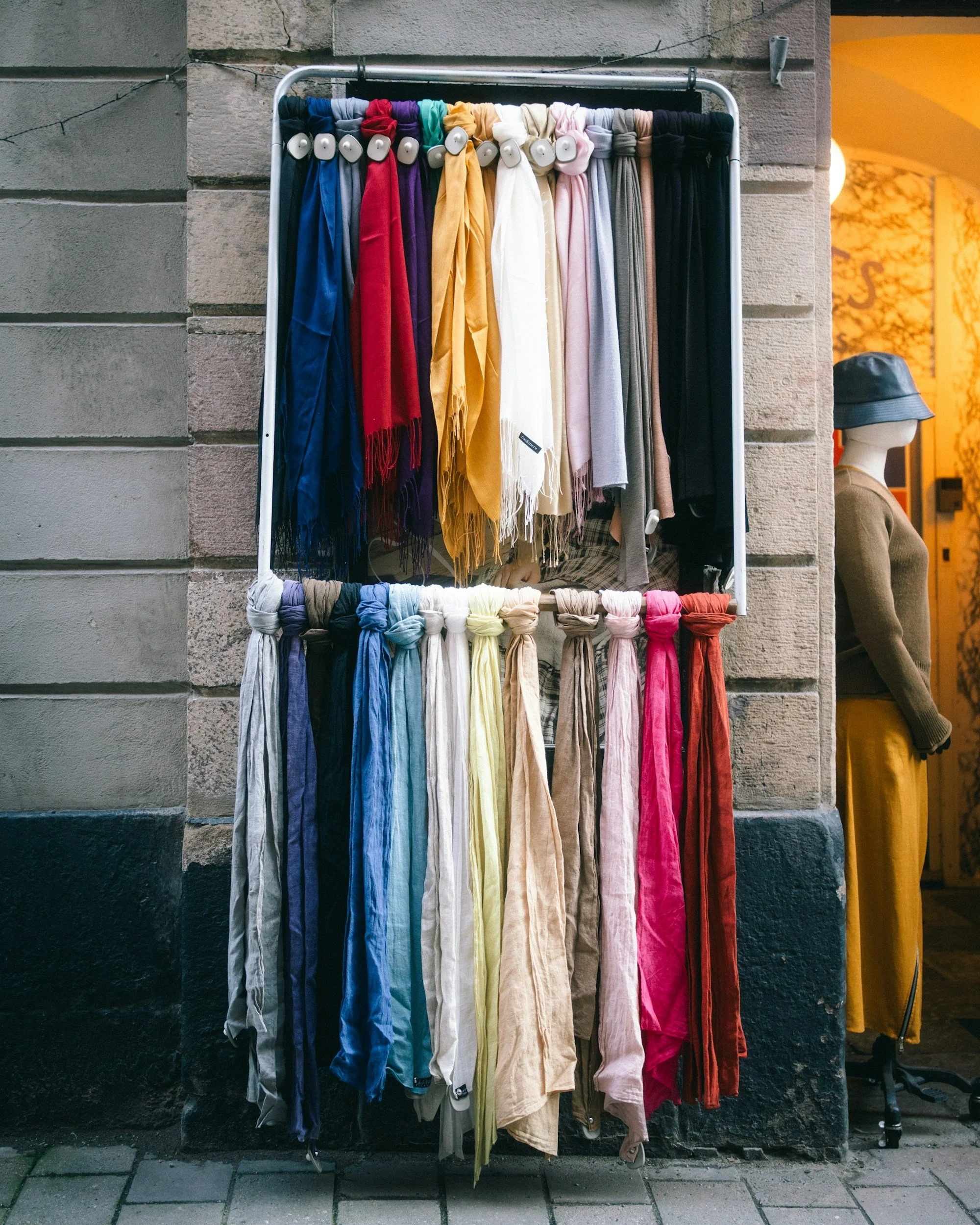
4 We’re given the rest of the afternoon to explore before we head out the next morning. Rose and I head to the souks, the famous market squares in Marrakech, which are packed with tourists and locals alike. It’s one of the most colorful places I’ve ever been; each stand is covered in fabric. As we walk across the medina, we notice a man holding a writhing snake, which he drapes around the shoulders of tourists seemingly at random and against their will. As they get over themselves and take pictures, he asks them for money. More men do the same thing, having tourists pose with monkeys on chains. The monkeys behave strangely like dogs in this environment, obeying every command of their owners. I try not to think about how the animals are treated. The streetside is packed with restaurants and tourists eating at the restaurants and looking out at this strange, exploitative endeavor.
As we reach the more packed store area, vendors shout at us from the stalls if we make eye contact with them for too long or if we want to stop and look at something they’re selling. Motorcycles periodically burst through the marketplace, grazing the pant legs of tourists. It’s incredible no one gets hurt. Men of all ages flirt with and catcall us relentlessly, and I wonder how the experience would change if we had a man with us. “You’re so beautiful, princess!” they shout after us in both French and Arabic. I buy expensive linen pants and a linen shirt from one of the few women working in the souks.⁷ Rose’s a lot better at dealing with all the attention than I am, and she flirts back to get discounts on the items she buys. “They want you to haggle with them,” she tells me, and I realize she’s right. There’s a bustling, competitive feel to the souks, and I’m overwhelmed and want everyone to look away so I can have a peaceful shopping experience. I only buy a couple of items the entire trip, feeling a bit uncomfortable with how badly it seems like some of these people need the money but feeling like I would be feeding into a tourist trap. The things they’re selling are of incredible quality for a decent price, and I do buy a pair of chunky sterling silver earrings and a ring for less than 50 USD, as well as a gift for my host mom.
Everything I read online about visiting Marrakech made it sound either like the Moroccans are out to get you, or it is their entire livelihood to make sure that you have a good time, which I guess in a way it is. I don’t know which is worse. You’re not supposed to buy the first price they tell you, not draw attention to yourself, not lowball too much, not aggravate any locals, not listen to anyone who tells you you’re going the wrong way, and not get tea with them when they invite you in the back of their store. The social codes are clear. All the blogs I read were extremely specific, complete with literal scripts for what you should say when haggling, which sort of defeats the entire point. They talk a lot about not being tempted by the tourist traps in the medina, the same way you wouldn’t buy a “designer” bag off the street in New York. There’s a disturbing “us vs. them” mentality to these blogs, which seems to be a perspective developed by serious travelers. I don’t love this as a representation of the U.S., and it’s another Woman Problem that I felt like I needed to read all of those and now have to think about the implications of them.
5 The next morning, we all pile into a 15-passenger van and drive ten hours to the Sahara desert. This is where the introductions happen in more detail, and we finally meet our guide for the next four days. Mo is tall, slender, and smirks a lot. He’s extremely young, close to our age, and he seems to navigate the trip somewhat mechanically, sometimes not knowing or announcing where we’re going next until it’s about to happen. None of the Fashion Girlies’ comments seem to faze him, and he often joins in on their conversations. He has been working at Skimming Morocco for four years, he says, and he tells us some fun facts about our first stop in Ouarzazate, where Gladiator and James Bond were filmed. The windows are teeny tiny cutouts in the houses because of the direction of the sun, and it looks like the houses themselves are shy, peering out to meet us. They are all identically orange. We climb up to a series of simple huts and visit an artist who paints and sells landscapes of the desert using only different kinds of tea. The paintings are all displayed on the walls of the rock and cost about 15 USD. Mo tells us that the town, which relies heavily on tourism and Hollywood productions to sustain itself, is owned by twelve families, which control who gets to live there. “Who are the twelve families?” I ask. He doesn’t know.
I can’t tell if the Moroccans all really love Shakira, or if they know that all the American tourists love Shakira and they use her to entice us. In particular, they love—or know we love—her song “Waka-Waka (This Time for Africa),” which plays at every single tourist-y restaurant and detour we stop by⁸. A couple of hours away from the camp, we stop at a store to buy pashminas, scarves to keep sand out of your face in the desert and protect you from the sun.
Unfortunately, this is an excruciating, 45-minute operation. The Fashion Girlies are concerned about which pashmina looks best with their current outfit, whether that cohesion will translate to their other outfits, and whether they are accidentally matching with anyone else on the trip. Their conversations are akin to picking a wedding dress, and they might be a bit ridiculous even for that (“does this white one match my accessories?” and “is it too much to get one with a little sparkle?”)⁹. I choose the most basic, most inexpensive one I can find and am done in three minutes. The Fashion Girlies take much, much longer. I try to chat with the women working at the store, but they don’t speak English or French.
After this arduous process, the women wordlessly dress us each in traditional Moroccan garb and escort us outside to a backyard where they start playing the “Waka-Waka” song. In one of the most shocking moments of the trip, the men who are guiding our tour hand us a huge Moroccan flag and tell us to dance, taking pictures and video for Skimming Morocco’s social media. The Fashion Girlies love Shakira and scream the words. Other men look on from the nearby stores. I try to avoid the gaze of the cameras as much as possible and stand by myself to the side. The Fashion Girlies take selfies in the traditional Moroccan dress. I have no idea what they’re even called¹⁰ and wait for this horrible procession to be over. After “Waka-Waka” and a couple other Shakira songs finish, the women help us take the garments off, draw henna tattoos on our hands, and escort us back into the van.
As we pile back in, I ask the Fashion Girlies in my row whether they felt like the whole “Waka-Waka” charade was a bit weird. “No,” they say. “Why would you think that?¹¹
¹Rose and I used one of the most well-known tourism companies in Morocco for this five-day Student Trip. In the interest of defamation, for reasons I will elucidate at a later time, I will refer to the company we used as “Skimming Morocco” to convey the depth at which I felt like I understood Morocco after partaking in the trip.
²Unfortunately, the trip did not turn out to be all-inclusive, and I would have been screwed if not for Rose, who brought plenty of cash for both of us.
³ This entire conversation is also happening in French, which makes keeping a friendly tone even more difficult. I default to French most of the time in Morocco, partly because I want to practice listening to another dialect and partly because I figure it will be easier for the locals than trying to interact in English. Moroccans used to only speak a dialect of Arabic, but once the French colonized them, the French forced them to incorporate more French into their language. Now, most Moroccans involved in tourism in any form (which is a lot of them, especially in Marrakech) speak French to accommodate their visitors. But I wondered at times whether I was unfairly cosplaying as a white Parisian or Canadian by speaking French, and which country was better to be affiliated with–would Moroccans think America under the Trump Administration was preferable to their own colonizers? What did my language convey, and what did I want to convey? Most Moroccans asked if I was French and couldn’t tell the difference between a real Parisian accent and an American trying to speak with a Parisian accent, which was a nice change because most Parisians clock your American accent before you even start talking. Rose and I had signed up for an English-speaking trip and surprisingly were the only ones on the trip who spoke French, which proved useful code for our what the hell is going on conversations which emerged.
⁴All the taxi drivers I meet in Marrakech are bilingual and chatty, and I’d read things online that advise you to pay close attention to the meter because they try to rip you off or not take you to the exact location you asked for because they want to get you to buy something at their cousin’s/uncle’s/son’s store. This only happens to me once, and luckily Rose and I are able to remove ourselves and navigate where we need to go. There are also apparently many illicit taxis, which was why I had the hotel call for one. What I’m trying to demonstrate here is that as a woman traveling alone (especially one who does not consider herself to be particularly street smart4a), there are so many extra things to be aware of, and I’m not sure how I should prioritize safety without insulting anyone. That’s one thing a certain cultural critic did not have to worry about in an unfamiliar location–his safety (at least not from other people, anyways). I believe, though, that this is mostly just a Woman Problem and not a Vacationing in Morocco Problem.
⁴ᵃI’ve never traveled out of the US by myself before this trip. I tend to keep my head down in situations where I’m in an unfamiliar public space, and I don’t think I’m extremely shrewd or quick in tense situations involving strangers. During my time in Paris, I made every effort not to walk home alone past midnight because I was so terrified I would be kidnapped on my well-lit, extremely short walk home from the metro stop on a street which housed mostly families and little old ladies who would smile sweetly at you, which doesn’t happen anywhere else in Paris. If I did happen to walk home late, I clutched my handheld alarm in my pocket the whole way.
⁵One of the Fashion Girlies is a model, like a real-life model, and we realize only when we look her up that she’s modeled for Kim Kardashian’s underwear and shapewear brand, Skims, among others. Pinned on her Instagram, this particular shoot is futuristic and depicts her wearing a cinching black push-up bra and sheer black tights over lacy underwear. She’s lying next to an electric blue pool rippling with veins of sun. Her arms are white and smooth. Her makeup is dark around the eyes and pale on the rest of her face. It looks like if you had a nightmare about the Kardashians in which they are aliens who came from their planet only to sell underwear to the good people of LA. The model looks, unsurprisingly, nothing like the pictures in real life–she’s pretty, but her features are softer and her hair hangs loose and frizzy. I find it difficult to reconcile these two versions of her; perhaps this is why she never brings up her modeling on the trip. The other Fashion Girlies have robust, consistent Instagrams with plenty of model-esque pictures (not to mention they all look like models), but it’s pretty obvious that they’re all jealous of the Kim Kardashian girl, who I will henceforth refer to as such.
⁶ It’s not difficult to tell which Fashion Girlies study each major. The Fashion Design Majors spend a portion of our ten-hour car ride to the Sahara Desert with a notebook out, drawing outfits. The Fashion Business Majors have extensive knowledge of how to market different clothes and how brands employ different marketing strategies. Rose chats with them about their shared love of thrifting, and the Fashion Girly Business Majors seem shocked at her knowledge of brands and the “industry,” as they call it. I spend my car ride alternating between journaling and staring out the window, taking great lengths to hide what I’m writing.
⁷I quickly realize that when the trip description called our experience “camping” they did not mean the sleep-directly-under-the–stars-wearing-the-same-clothes-for-three-days camping in the desert I had assumed. Instead, we sleep in completely covered tents on cots with running water a short walk away. The Fashion Girlies do not seem like the types to seek out experience washing their dishes with dirt; they arrive armed with at least one full suitcase each. Unfortunately, in the spirit of real camping, I only brought one complete outfit for the entire trip: a plain white t-shirt and loose brown pants which are still too warm for the desert. I end up borrowing a lot of Rose’s clothes (and accessories, which seem to be just as important as clothes in this group5a ) and also taking only one shower the entire trip, which I believe looking back was some sort of internalized rebellion against the whole inauthentic “camping” thing.
⁵ᵃ Each of the Fashion Girlies buys one of those belts with the leather circles and coins, as well as armcuffs and plenty of jewelry. They are all jewelry maximalists, with rings on at least seven fingers and no less than five piercings each. They could pull up to Coachella post-souks to see Charli xcx perform live and not change a thing.
⁸I myself have a mostly neutral opinion of Shakira, with an exception being her incredibly inspired portrayal of the fictional pop star, Gazelle, with accompanying original songs⁸ᵃ in the Zootopia and Zootopia 2 films, both of which I recommend to the reader if they have not experienced them already. It’s astonishing how accurately the Disney animators captured Shakira’s spirit in a cartoon mammal.
⁸ᵃ!
⁹You might think they would decide this much faster given that their clothing options are fixed, but I quickly realize that if one is to be a true Fashion Girlie, she builds outfits out of individual pieces. Pashminas are confounds to a plan that was already in full motion. Activities of the day, accessories, and what everyone else is wearing must be accounted for.
¹⁰After some searching, I believe the garments were either kaftans or gandouras, which have both been traditional garments in North African life for centuries. Kaftans are often worn to weddings or other ceremonies and feature handmade embroidery on silk. Gandouras are more informal and flowy. I can’t remember whether the garments they had us wear had long sleeves, which would narrow it down to a kaftan, but I made sure not to take any pictures in the moment, so I don’t have it to look back on. The headpieces were likely taounzas, which are believed to ward off negative energy. They are also a sign of cultural pride–hence, I guess, “Waka-Waka” in the background. (See source.)
¹¹This is the first concrete instance of me establishing myself as definitively not compatible with the Fashion Girlies. I’m the weird girl who uses the breaks to journal in the tent or in the car and asks about cultural appropriation. I take copious notes about the food I eat, the predicaments I feel myself in, and my impressions of the people I’m with. I imagine the Fashion Girlies put two and two together and realize that I’m a bit uncomfortable with some of the things happening on the trip, and I decide pretty quickly that I don’t want to try to make them like me. I observe a different, friendlier attitude in Rose, who often asks the Fashion Girlies their opinions on her outfit choices or whether they could take her pictures (probably also because I’m not very good at it, not that Rose would actually say that). Maybe she’s a better person than me. The Fashion Girlies probably see me as a pretentious snob on this casual trip, an overintellectualizer who can’t enjoy herself. I wonder the same thing myself, whether I should just relax and take in the beautiful scenery and wear the kaftan if they give me a kaftan. But I feel being observant, eloquent, and critical is part of me I can’t shake, even if I wanted to.
No, that’s not quite it. The Fashion Girlies have incredible perception for what looks good in a picture or an outfit, and they criticize their own appearances every chance they get. I guess there’s an underlying usefulness that I’m associating with myself, how I have more to contribute to the world and this trip with my philosophical mind, how I know what is politically correct and write things down, and this gives me some sort of moral high ground. I can’t tell at what point I’m being productively critical and at what point I’m being elitist. All I know is that the Fashion Girlies definitely had more fun than I did.