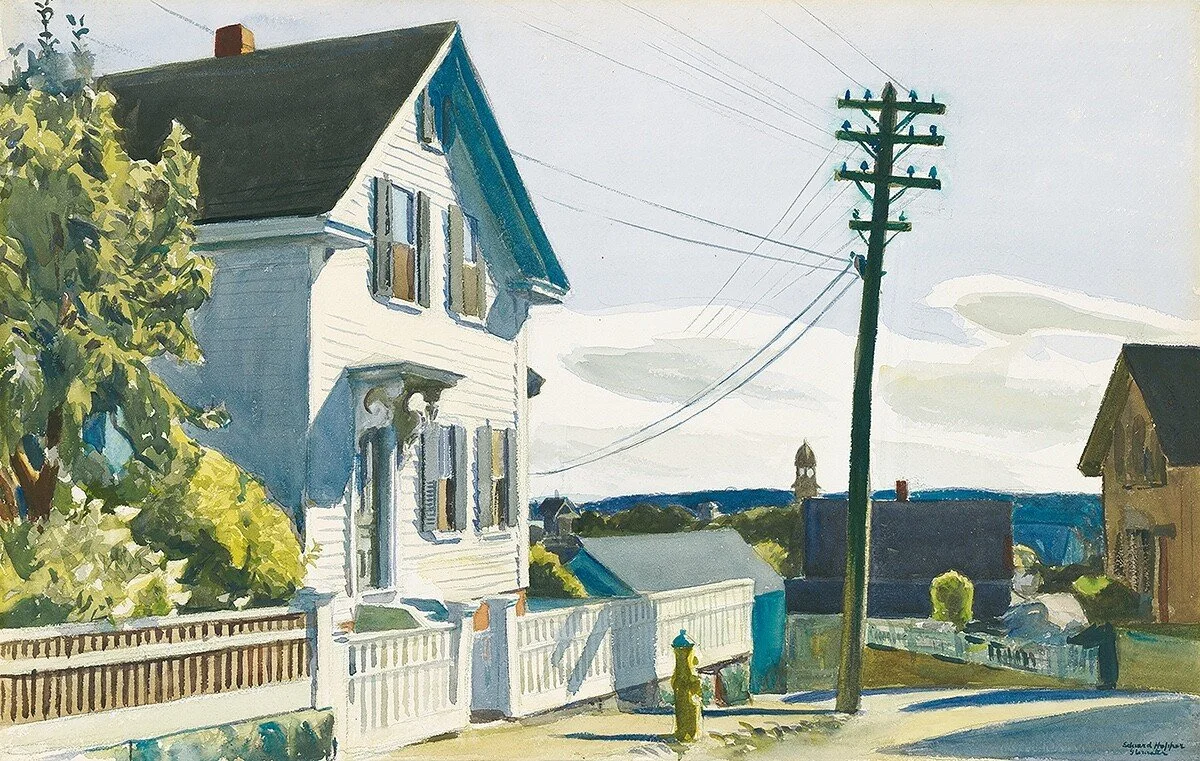
Good Fences Make Good Neighbors
Marianne Janack
On the old saw about fences and neighbors
She sat in the La-Z-Boy recliner, which was covered in a green velour that mimicked wide wale corduroy. The chair, which swiveled, was near the large picture window, through which she could see the grey afternoon light of late autumn, and the houses across the street, all of which looked like this one: small ranch houses with wood siding; some were given uniqueness by their owners with fake brickwork or front entrance ways. Our house, next door, looked just like hers and all the other houses on the street.
She told my sister and brother and me that she’d always had “great gams”, kicking her slippered foot toward the ceiling, showing us her calf, still firmly muscled, sheathed in fine beige pantyhose. “Isn’t that true, Scotty?” She threw her head back, laughing, her amber-colored eyes twinkling, her wavy chestnut brown hair well-coiffed, expertly dyed. She wore a quilted pink and white bathrobe which partly covered her stockinged legs.
“Yes it is, Mom”. Scotty gave her a grin, his thin sandy hair and blue eyes making him seem younger than his 30-odd years. He shook his head faintly, as if to say, “you’re a hoot.”
She was.
Mrs. McManus moved into the house next door to us after the Fedrizzis moved out in 1975. taking their five children to a bigger house. There were too many Federizzi children for too few rooms in the little house. The four girls shared one room; the only boy, Ricky, was in another room; Fran and Carl shared the smallest bedroom, off the kitchen. Fran, the mother of the family, had been a friend of our mother’s, even though her son had been responsible for the fact that I’d lost the sight in my right eye when I was 4 years old. This was a tragedy that we all just let go, and forgot about—or at least it seemed that my mother was able to fence it off from her friendship with Fran. They would talk to each other on the phone, and in the adjoining backyards. We all loved Fran.
The Fedrizzis hadn’t moved right after the accident. They had stayed another 6 or 7 years, Fran acting as our softball coach and the leader of our Brownie troop. She coordinated cookie sales and camping trips from her tiny Formica kitchen table, wearing her black cat-eyed glasses—always exuding energy. We all wondered how she could be so energetic—all those kids, a job, and the Brownies.
Carl, her silent husband, seemed only to come and go though we didn’t see him. I’m not sure that I ever saw him doing anything other than drive away in the mid- 60s bronze-colored Ford station wagon that they’d owned for the whole time we’d lived near them. For all I know, they still own it, 50 years later. Indeed, I imagine them going on as they are in my memory—the kids never aging; Fran and Carl still wearing their 1960s hairstyles and patterned polyester parents’ clothes.
I don’t know where they moved to, or how they managed to come up with enough money to buy a bigger house than the five-room ranch house that was like every other house on our street and every street around us. But they did. And when they moved out, the McManuses moved in.
Mr. and Mrs. McManus--older, retired--had moved in with their dog Blackie, and after a couple of years put up a fence around their yard. Their adult sons, Robert and Scotty, visited fairly frequently. We kids—my sister, brother and I—did, too. We liked talking to Mrs. McManus, and we liked Blackie. Even though we had a dog of our own—a dusty matted poodle-mix who had only answered to the name ‘Pup” since he came home with us as our first pet in 1970—we still liked to visit other people’s dogs.
I dreamed of Mrs. McManus last night, sitting in her recliner, showing us her gams, reminiscing about her youthful attractions.
I’ve always wondered about the adage about good fences making good neighbors. Is the idea supposed to be that fences set boundaries on what belongs to whom, so that there can be no dispute about ownership? Is it about containment, rather than ownership? Is the idea that our neighbor’s fence will keep our dog in his yard and keep our piles of unused firewood, our trees, from escaping into the neighboring yard? Does a fence allow for hiding and privacy that are essential to living near others? Is the fence itself the good neighbor? Or are the people whose yards and property are divided by the fence good neighbors to each other as a result of the fence? Who builds the fence? Do they build it together? Or does one party take the initiative to build the fence and maintain it, fixing holes, painting it, replacing parts that have been knocked down in storms?
My father wasn’t that enthusiastic about our visits to Blackie and the McManuses. “You know, you have your own dog here,” he would say, with a slight tone of accusation. Of course we knew that. Pup spent much of his time chained to a tree in our backyard. He’d never been to a vet, had rarely eaten proper dog food—he ate our leftovers, mostly, or food that we wanted to share with him. We weren’t uninterested in him. He was just familiar now, the dog we had always had, who lived with us, who was, in a sense, part of the furniture along with the dirty laundry, the cracked and worn green vinyl La-Z-Boy recliner in which our father sat reading the newspaper––it didn’t swivel. But as in the McManus house, it was placed near the front picture window. The gold curtains in our house--utterly familiar--which hung in front of the picture window were usually drawn against the neighborhood and the street, keeping us private and separate.
Sometimes a fence makes you see your property in a different light--from the perspective of the neighbor. Did the McManuses disapprove of the fact that our dog spent much of his time chained to a tree in the backyard? Or maybe they objected to the mess that was our backyard: piles of wood, an above ground pool that had some rusty panels, aluminum ladders, a rusty old metal shed back in the corner of the yard? The straggly pine trees and the unhealthy white lilac; the weedy flower bed from which purple irises would sparsely grow, struggling through the plants that nature had herself put there without our intervention, and which we let grow?
The McManus’s fence was a stockade style fence, made of wood and painted the color of redwood, to look natural. An expensive fence, my father said. It was the only one on the street at the time. My sister says now that they put up the fence so that Blackie could roam freely in their backyard. But I wonder about that. It seems to me that our parents became less willing to let us go over to visit after the fence went up, Maybe I’m wrong about that, but my parents seemed to think that the fence was a message—an unneighborly one.
Maybe it is just a coincidence that my sister, brother, and I stopped going over to visit the McManuses shortly after they had the fence installed. We were growing older—we were busy with our friends, and I had a job after school as a janitor at the local Coca-Cola factory. I suspect that Mrs. McManus missed us—we would still yell ‘hello’ when we saw her in the yard, but for whatever reason we didn’t go over, didn’t listen to her tales of being young and beautiful, her stories about what Syracuse was like in the 1940s, when streetcars ran along the downtown streets and she worked in a local factory.
1975 became 1980, and the McManuses moved away—Blackie had died a few years earlier. I think someone said that Mrs. McManus had to go into a nursing home. I’m sure that they are both dead by now, but, as with the Fedrizzis, they may well be living their lives somewhere else, in another house, with other neighbors separated by other fences.
Our dog, Pup, was still with us until 1983, my first year in college. He got loose from his chain (he would do this every once in a while—we’d find him roaming the neighborhood, dragging the chain behind him), and we never found him. At least he’d been free to roam and be his doggy self, we thought. And our yard continued to collect ladders and wood and random trees.
The stockade fence is still there.